Welcome

So a long time ago (the mid-1990s), the greatest writer in comics agreed to take over the writing duties for Image Comics' Supreme. He would radically reshape the character, the book, and due to forces beyond his control, a whole comic book universe. And it led to an award-winning run of comics, three additional titles (among several proposed) and ultimately led to the genesis of Moore's much better known America's Best Comics. And then it all went out of print and was forgotten by way too many.

Having gathered quite a bit of information about Moore's Supreme and Awesome runs, I decided to create a home for the forgotten Awesome. Over the course of a year, I put it all together here.

Each week I did a main "Weekly Reading" post that was a read-through of that issue. I followed that up with a couple of other posts about topics from that Weekly Reading or whatever else I came up with to talk about. You'll find the lost Youngbloods in the Youngblood section and the fan-edit of the last Supreme in After Awesome.

Below is the archive of posts broken up by book. Thanks for checking the site out!

Book 1: Supreme: The Story of the Year

Book 1: Judgment Day

Book 3: Supreme: The Return

Book 4: Youngblood

Book 5: Glory

Book 6: After Awesome

Book 7: 1963

Book 8: Night Raven

Book 9: A Small Killing

Friday, May 18, 2018

After Awesome Part 9: John McLaughlin's Youngblood

(Welcome to After Awesome, where I take a look at all the subsequent series having to do with the characters from Moore's Awesome Universe.)

In 2012, John McLaughlin, a screenwriter for the movie Black Swan, wrote the relaunch of Youngblood. Like the other revived Extreme books at the time, it reverted to Youngblood's original numbering (which makes no sense since it largely ignores much of what came before), starting at #71. I've watched some of McLaughlin's movies and TV and I have no idea how he came to write this series or why it is as awful as it is, but wow is it terrible. To top it off, Rob Liefeld wannabe Jon Malin handled the art and it compliments the shitty writing perfectly.

This arc follows a reporter from Entertainment Now magazine as she is embedded with Youngblood to write a nice puff piece on them. This Youngblood is made up of Die Hard (back to being a cyborg), Cougar (now a horndog), Vogue (a female horndog, mostly, but not exclusively, lusting after Die Hard), Lady Photon (who was an alien he but has now become an alien she) and a new Shaft (Jeff Terrell marched into President Obama's oval office to quit).

Terrell has returned to the F.B.I., where he is investigating a weird serial killer, who is killing future incarnations of Vogue and sending them back in time for him to find. That sentence was the most interesting thing about this arc and it was never resolved, basically because this is a Rob Liefeld comic.

There's also an ongoing B-story about Badrock who is in some kind of coma. He nearly died when he used his body as shielding for a space shuttle that was re-entering the atmosphere. But something punches out of the shell of Badrock. We never find out what, basically because this is a Rob Liefeld comic.

Anyway, Youngblood's first mission is to deal with a bunch of clones of a wannabe model at a mall. They handle it by punching out the original girl, who popped out the clones as a stress mechanism.

McLaughlin tries to make jokes about modern mass media, but as he's not as savvy as Joe Casey was, it just comes across as amateurish. Well, it's all amateurish, really:


Then Die Hard is being honored by some military bigwigs in Washington. Something turns the dead in Arlington Cemetery into zombies, who attack. Youngblood dispatches them, but then it turns out to be some conspiracy by a police gear-garbed alien/demon, who has somehow possessed President Obama:


But since it's never mentioned again, I guess it wasn't that important.

That's one of the major problems of this arc. McLaughlin writes the action so poorly and wraps things up so stupidly that it took me a while to realize that each issue is a standalone story and none of it adds up to anything.

The next issue dealt with a bully gamer who picked on another character in a video game. She got revenge by sending a real axe-wielding beast to kill him through the internet. But Youngblood took care of her by killing her in real life, too. Case closed!

Then Youngblood goes to Las Vegas to find out why all of the people are missing. Turns out an alien gambler won them by playing a game of cards with the mayor of the city. (Jesus Christ, were there no editors at Image who could say this was a stupid idea?) He offers to play Youngblood and if they win, they can have the people back, but if they lose, he gets the entire planet. Instead Vogue hits him and the people are saved.


The Entertainment Now article about Youngblood comes out and says Youngblood is great. That was an entire issue.

Then we get an issue that promises to reveal the fate of Badrock! But it's a flashback to him on the space shuttle and Jeff quitting because of it, so it doesn't reveal anything. And that was McLaughlin's last chance to reveal anything because starting with issue #77 Rob Liefeld took over writing the story and hit reboot on the whole thing again. Yagh!

Now Troll and Chapel's son reincarnate the original Chapel, who is still a lord of Hell. (All of this is from the early days when Rob Liefeld's Youngblood played in the same sandbox as Todd MacFarlane's Spawn.) 

Badrock puts together a whole messload of old Youngblood members to fight Chapel, including Moore's Youngblood members. They're all needed as Chapel opens a portal to hell, which comes through to terrorize New York (always New York!). Of course that fight never happens because the series ends on a cliffhanger in issue #78... say it with me now... because this is a Rob Liefeld comic.

I feel dumber for having talked this long about this comic.

Next time, let's look at one of my favorite bits of After Awesome: Bloodstrike. No, seriously.

Wednesday, May 16, 2018

After Awesome Part 8: Erik Larsen's Supreme

(Welcome to After Awesome, where I take a look at all the subsequent series having to do with the characters from Moore's Awesome Universe.)

I've already discussed Erik Larsen illustrating the last Alan Moore Supreme script back in this weekly reading. In May 2012, he started writing his own issues so we could see what happened when the Daxes attacked the Citadel in Supreme #64. I remember back in 2012 being so excited for the last Moore script that I was willing to overlook everything I had ever thought about Erik Larsen and give him the benefit of the doubt on his continuing with Supreme.

How could it go wrong?

It ended up being a short run where he brought back Rob Liefeld's "Mean" Supreme while also dealing with the fallout to Alan Moore's Supreme characters. "My thought was to marry the two and take what Alan had done and what came before and try to find something in the middle which might appeal to both audiences," he said.

Oh...yeah. That's how it could go wrong.

Picking up immediately after Supreme #63, the Daxes downed the Citadel and when Supreme and Diana opened the door to the Supremacy, the Daxes blew up the Supremacy. They decimated all but a handful of the Supremes, including Radar (Larsen ignored the fact that Radar was off on his own planet). New Supreme and Original Supreme decide to let Rob Liefeld's Mean Supreme out of the prison where he'd been chained since Supreme #41. He kills all the Daxes and then finds silver supremium in the Citadel wreckage, which he uses to strip the five remaining Supremes of their powers.

It's not a particularly good start to Larsen's run for fans of Moore's Supreme.

From there, Larsen separates the book into two parts. The first involves Mean Supreme feeling betrayed that no one came to rescue him for the last 24 issues (he acknowledges that it was a decade and a half). He goes and beats up Super Patriot, demanding to know why he didn't help. Super Patriot says that Supreme was always so confident, how were they to know he needed help, when he never needed it before.

The better part of the book involves the five non-powered Supremes: New Supreme, Sister Supreme, Fifties Supreme (with lion head), Original Supreme and Squeak. When the military takes them into custody, Suprema goes to rescue them. But New Supreme tells her that they have to cooperate with the authorities.

While Suprema goes to confront Mean Supreme, Ethan and Diana discover that Dazzle Comics and all the other aspects of their existence are gone, including Ethan's whole apartment building. When they go to Diana's apartment, she has a message on her answering machine from a boyfriend named Ken. Um, what? Did she always have a boyfriend or is that just in this new revision? 

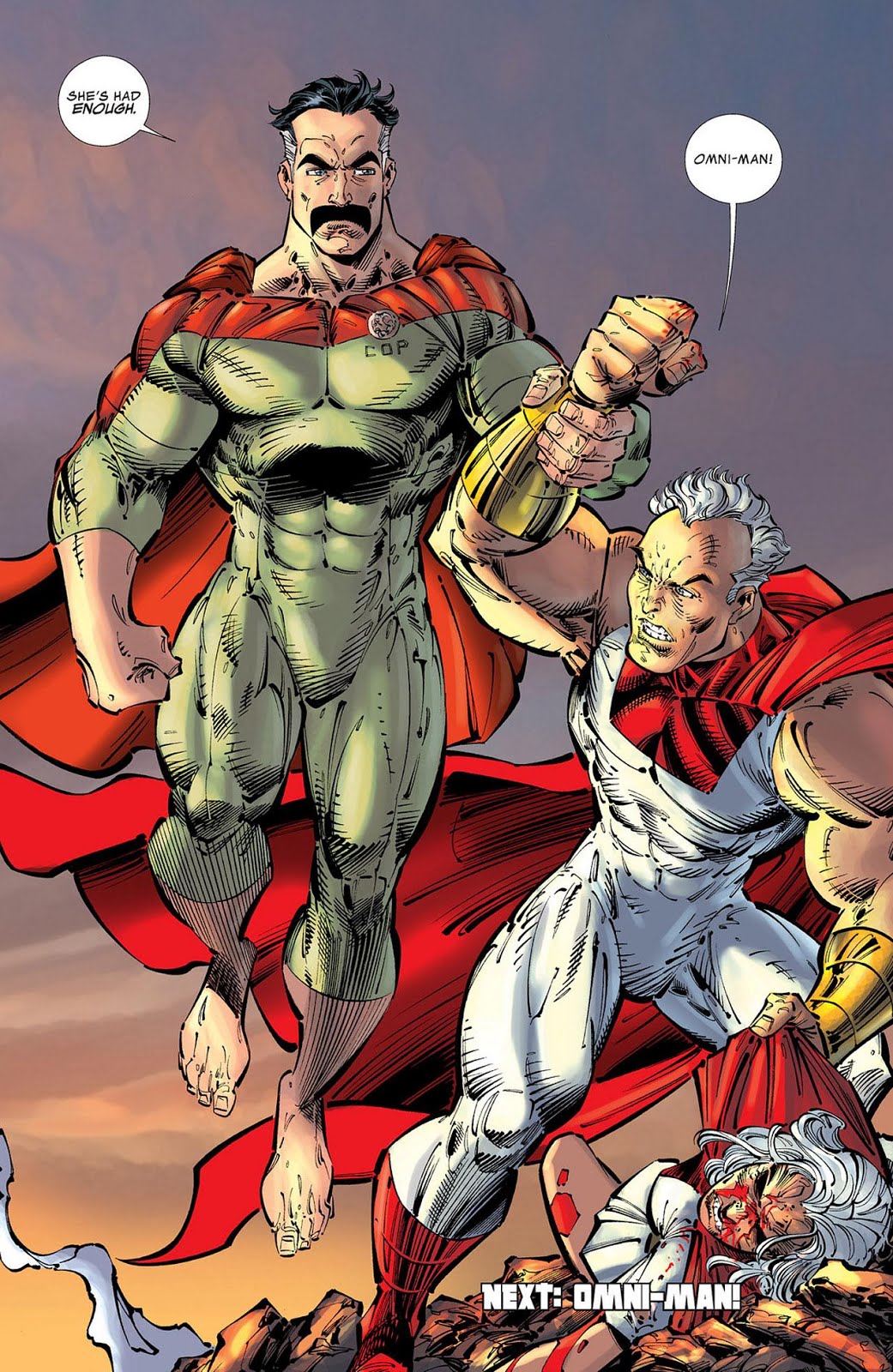
Suprema and Mean Supreme end up in a fight where Mean Supreme beats her into a bloody pulp that is so beyond the boundaries of good taste that I'm not sure how Larsen thought he could possibly appeal to fans from the Moore run. Just as he's about to finish her off, this revised universe's Omni-Man (an alien from Image Comics' Invincible series) comes and fights Mean Supreme to a standstill.

Ethan rescues Suprema and takes her to the hospital. He is also thinking about moving on with his life and getting a new job as a comic artist. But the other non-powered Supremes want to do something about Mean Supreme. They decide to team up with the only Dax who survived the Dax massacre, Darius Duck, who gives them gloves that can help them steal Mean Supreme's powers.

Mean Supreme, unconscious from the fight with Omni-Man is abducted by an old Liefeld villain, Khromium, from an antagonistic alien culture.

By issue #68, the writing was on the wall for the Erik Larsen series as Cory Hamscher, the artist who finished Larsen's layouts, left the series. The result looks like barely-finished chicken scratches, which suggests that no one finished the layouts and they just put it out anyway. But it doesn't really matter, since this was the last issue and it doesn't end with any real resolution.

While Mean Supreme kills Khromium and all of his race, Ethan realizes he doesn't have any artistic abilities without his Supreme powers. He ends up sleeping with Sister Supreme. They discuss whether it was even possible for the Daxes to have destroyed the Supremacy, since it was just a limbo realm, and that maybe the real versions of themselves with their powers are now in the real Supremacy. I took this as Larsen acknowledging the Moore fans who hated Larsen's version, and that their version still existed somewhere in the Supremacy.

Meanwhile, Diana goes to see Suprema in a coma in the hospital. She says she remembers being Supreme's girlfriend and that she's pregnant.

The end.

Larsen has the audacity to say in the letters page that he always planned to "do the book but just long enough to set the pace and get the ball rolling. And now my job is done."

Bullshit. The sales on the series were awful and it was clearly cancelled before Larsen thought it was going to.

And as with all Rob Liefeld series, none of it mattered because the next team ignored all of this and did something new. We never find out if the Supremes are in the Supremacy. We never find out what happens with Mean Supreme, or Diana and her baby, or if Suprema recovers.

Now there's quite a lot of this arc on the series that I not only don't like, but actively hate. Everything with Mean Supreme, which was mostly mind-numbing overlong fight sequences, was a total waste. The way Larsen abuses his characters, especially shooting Radar and beating up on Suprema, show a complete disregard for common decency, which was one of the hallmarks of Moore's run on the series.

But there are elements that work. The subplot about Ethan having lost his abilities to draw along with his Supreme powers is a nice touch, and almost everything involving the powerless Squeak is a lot of fun. While I don't like the idea of Ethan and Diana having a falling out, the character of Sister Supreme was a hoot and a unique character for Ethan to interact with. And Cory Hamscher's art really had a nice, comic look to it that made the series easy on the eye. There was potential here and I wonder what would have happened to these characters if the series had continued.

Ultimately, these issues seem like a lost opportunity to continue Moore's series and find new stories to tell. Larsen was right not to try to duplicate what Moore did, but Larsen was the wrong choice to lead the series forward, as few people really missed Rob Liefeld's version of Supreme. And no one wanted him to try to split the difference between Moore and Liefeld.

Up next... wait, what? Yet another shitty version of Younglood? Yay.

Monday, May 14, 2018

After Awesome Part 7: Joe Keatinge's Glory

(Welcome to After Awesome, where I take a look at all the subsequent series having to do with the characters from Moore's Awesome Universe.)

Glory #23 began the 12-issue series with writing by Joe Keatinge and art by then-Ross/now-Sophie Campbell. It's a weird story about a battle-worn superheroine dealing with her dysfunctional family and some sort of intergalactic war. It's one of those series that seems well written until you start thinking about how all the parts really don't fit. The art is lovingly brutal. Combined with some great color work, this is one of those series where it's almost better to just look at it.

But man, the continuity is all over the place. It takes some elements of the Moore version (even the Danger Damsels and Gloria West) and throws out other parts, which is okay, as this isn't really the Moore Glory.

The story follows a girl named Riley, who has some sort of psychic connection with Glory. She sees Glory's adventures in her dreams:


So, those are pretty similar to the ones Moore created for the background of his Glory. But it isn't the same. There's also this awful characterization of (maybe) a new Supreme, from back when he worked with her in WWII:


There are so many things wrong with this scene, from the characterization of both heroes to the god-awful dialog: "You care about the greater good, despite somehow having narcissistic motives. If anything, you amused me. Finding something to laugh about is rare during wartime." Ugh.

Fortunately, the series focuses on Riley, who is a much better character. She travels to France and finds Gloria West, Moore's waitress:


The series never makes it clear how Glory went from sharing a body with Gloria to now having her own, but it's hard to accept that this really shares continuity with Moore's work at all. So it's better just to ignore it.

Gloria is hiding an injured Glory. Glory has been injured from the war between her family's two different warring sides. Both are aliens, but one side is godlike (the Demeter side) and one is demon-like (the Silverfall side). Glory prefers to live on Earth, but she knows the demons are coming for her. She trains Riley to fight as best she can, but Riley knows that she has a purpose in this story that probably isn't fighting. Through her dreams, she realizes she's here to stop Glory.

Silverfall and his demons turn up and start fighting with Glory, but she kills all of them. As she does, we come to see that when she fights, she gives into an overwhelming rage that can get out of control. 

As the adventure continues, we get to meet Glory's allies, a wonderful hoarder alien named Henry and a flying cat thing named Beleszava. Then they team up with Glory's potty-mouthed, awesomely savage little sister, who is always ready for a beat down on dear, old dad. These side characters are really the strength of the writing and are so enjoyable to spend time with that it makes the series seem better than it really is.

The group travels to Paris, where we learn about some of Glory's history, including this wonderful, seemingly Moore-inspired, historical tale of Glory and the lost generation of writers in Paris capturing an evil criminal:


The group confront Lord Silverfall, who tells them that they all have to work together to fight off a "knight of Thule," which destroyed their homeworld and will soon threaten Earth. So Glory calls in all the heroes of Earth she can find:


It's such a wonderful collection of heroes and this is almost the only page we get to see of them. Anyway, the giant monster knight shows up to attack Tokyo (because of course it does) and the heroes go there to attack it. Glory directs most of the heroes to deal with the smaller attackers or civilians, while the more superpowered heroes deal directly with the knight.

Badrock gets attacked by some alien things, so Supreme hurls him at the ground and then throws a hissyfit because Badrock might have gotten killed (but it's Glory's fault?):


Seriously, this makes no sense. Why would Supreme attack Glory in the middle of a battle in which we've seen no one die yet? Whatever.

So Glory goes nuts. She takes out the knight but then can't be stopped. They figure she'll tire of killing people in a few years or decades. Riley decides that she understands her role now and sacrifices herself to Glory to make her come to her senses.

For the last issue, we flashback to see that Glory has been in love with a French woman named Emilie since she arrived on Earth in France in 1913. But as she aged and Glory didn't, Emilie eventually killed herself. 

Now, after killing Riley, Glory decides to take a trip to the underworld, which is just a boat ride away. There she sees Riley and Emilie and all the others. They forgive her for killing them and remind her how much they still love her.

It's nice, even if it's not as profound as it seems to think it is.

Glory goes back to the world of the living and she and her family take off in a space Winnebago. The end.

There are rumors that the creators were told to hurry up the ending, which makes sense, since the ending didn't feel completely right. But then again, the series was like that all along, so who can say.

There are some wonderful parts to the series and some truly WTF moments, even independent of the non-Moore continuity. It's well worth a read, even though it makes it clear that we're never going to get any kind of continuation of Moore's Glory. If we're lucky, maybe his remaining scripts will turn up someday.

Next time, we'll see how well Erik Larsen did trying to continue Moore's Supreme.