
Welcome

So a long time ago (the mid-1990s), the greatest writer in comics agreed to take over the writing duties for Image Comics' Supreme. He would radically reshape the character, the book, and due to forces beyond his control, a whole comic book universe. And it led to an award-winning run of comics, three additional titles (among several proposed) and ultimately led to the genesis of Moore's much better known America's Best Comics. And then it all went out of print and was forgotten by way too many.

Having gathered quite a bit of information about Moore's Supreme and Awesome runs, I decided to create a home for the forgotten Awesome. Over the course of a year, I put it all together here.

Each week I did a main "Weekly Reading" post that was a read-through of that issue. I followed that up with a couple of other posts about topics from that Weekly Reading or whatever else I came up with to talk about. You'll find the lost Youngbloods in the Youngblood section and the fan-edit of the last Supreme in After Awesome.

Below is the archive of posts broken up by book. Thanks for checking the site out!

Book 1: Supreme: The Story of the Year

Book 1: Judgment Day

Book 3: Supreme: The Return

Book 4: Youngblood

Book 5: Glory

Book 6: After Awesome

Book 7: 1963

Book 8: Night Raven

Book 9: A Small Killing

Friday, November 17, 2017

The other Awesome comics: Coven

Welcome back to the ongoing feature where I read the other comics published by Awesome that ran alongside Supreme. I read them so you don't have to! (You don't have to thank me, but you should.)

After working with writer Jeph Loeb on Cable for Marvel, penciller Ian Churchill came to Awesome with the idea for a series. While the rest of the Awesome Universe focused on the super side of comics, the Coven would explore the mystic underworld of this universe.

Christina Baker, a young, plump African-American woman is our entry person point of view for the series. She's your average college student who happens to get headaches when supernatural occurrences are close by (I always assumed my headaches in college were from different causes, but maybe I just missed my chance to go on some poorly-plotted supernatural archeology adventures. Drat.)

She soon discovers two very supernatural people stealing from the university's museum: Scratch (a possessed priest) and Fantom (a French vampire). Both are members of the Coven. Soon, the evil Pentad show up and they sit down and talk reasonably about their differences. Oh, wait, no, they battle.

The leader of the Coven, Blackmass, soon arrives and recruits Christina to the world of magic and mysticism and explains how the Coven are trying to defend the world. He also explains that the Pentad are their evil counterparts.

There's another character, Spellcaster, who is a California surf girl who is also a white witch. When she sees her mother killed by a member of the Pentad, she vows revenge and works with the Coven to get it.

We follow the two groups as they collect artifacts that will allow the Pentad to resurrect Cain (of Cain and Abel) who will become the new king of men (just because).

(There must have been something in the water at the Awesome offices... perhaps holy water?... that so many series have to do with biblical references and angels and demons.)

Fortunately, Christina rejects the Pentad's offer to become a more powerful person and helps save the day. But before it ends, the leader of the Pentad mortally injures another member of the Pentad, who was secretly a spy and lover of Blackmass, even though we never knew about her or cared about their relationship.

Um...right.

Look, it's not a particularly good series. It's a bunch of characters who should be interesting, but aren't. We're not given a lot to care about them, we don't get to delve into their pasts any more than superficially and the most important thing is that we understand their powers.

The weird part is that they could have been interesting. Take Scratch. He's a priest who is partially possessed by a demon. That has potential. Instead, he's only shown to be a lecherous, wise-cracking, red-skinned devil. Who cares? We don't see any of the inner conflict. He's just another jokey miscreant in an artform littered with them. If he didn't have red skin, he could be Gambit. Meh.

One thing that struck me as I was reading this is that Jeph Loeb is a frustrating writer because he's so hit or miss. This is the same guy who found a way to make Fighting American distinct from Captain America. But he can't make this anything interesting?

I imagine that a lot of it has to do with his collaborators. My theory is that if Loeb got overpowered by his artist's ideas, the story just disappeared into mush. But if he had a good collaborator, as on the Rules of the Game miniseries or the first Kaboom series, the art and the story work together. (Way to go out on a limb Mike: When the artist and writer work well, the series work. Brilliant deduction!)

It's also hard to escape the problem of Churchill's art. He's clearly a gifted artist, but he can't help but draw his women mostly unclothed and they all start to look alike. That his main character is a plump African-American woman with blonde hair is about the most refreshing aspect, but just highlights his lack of discipline to draw any other woman as anything other than a nearly-naked supermodel.

It's exactly this base instinct that Alan Moore pushed so hard against in creating Suprema. By being a modest-looking, conservatively dressed young woman, she stood out from all the other Awesome characters, and most of the other women in comics in the 1990s. Just as Moore planned.

As long as we're talking production, I also can't decide about the garish pastel coloring with bright pinks, yellows and baby blues. It's clearly from the mid-90s and is kind of great for that, but man it's also too much.

Okay, back to the story. To be honest, once it got rid of the main Cain arc, the Coven got a little better, as the next arc was about a goblin infestation at a brothel. It's treated with humor and doesn't take itself too seriously. But as we still don't particularly care for the characters, this arc doesn't matter any more than the first.

There's also a recurring subplot about someone tracking down Christina, who on the last page of the first series, discovers some weird black cat woman we never see or gets mentioned again in any of the Awesome series.
The creators must have recognized that they were having characterization problems because they put out a one shot called Black and White (which seems to be the uninked pages from the later sort-of completed Dark Origins one-shot and a backup from one of the Lionheart issues... because it's Awesome, of course) in which we got short stories about three of the characters.

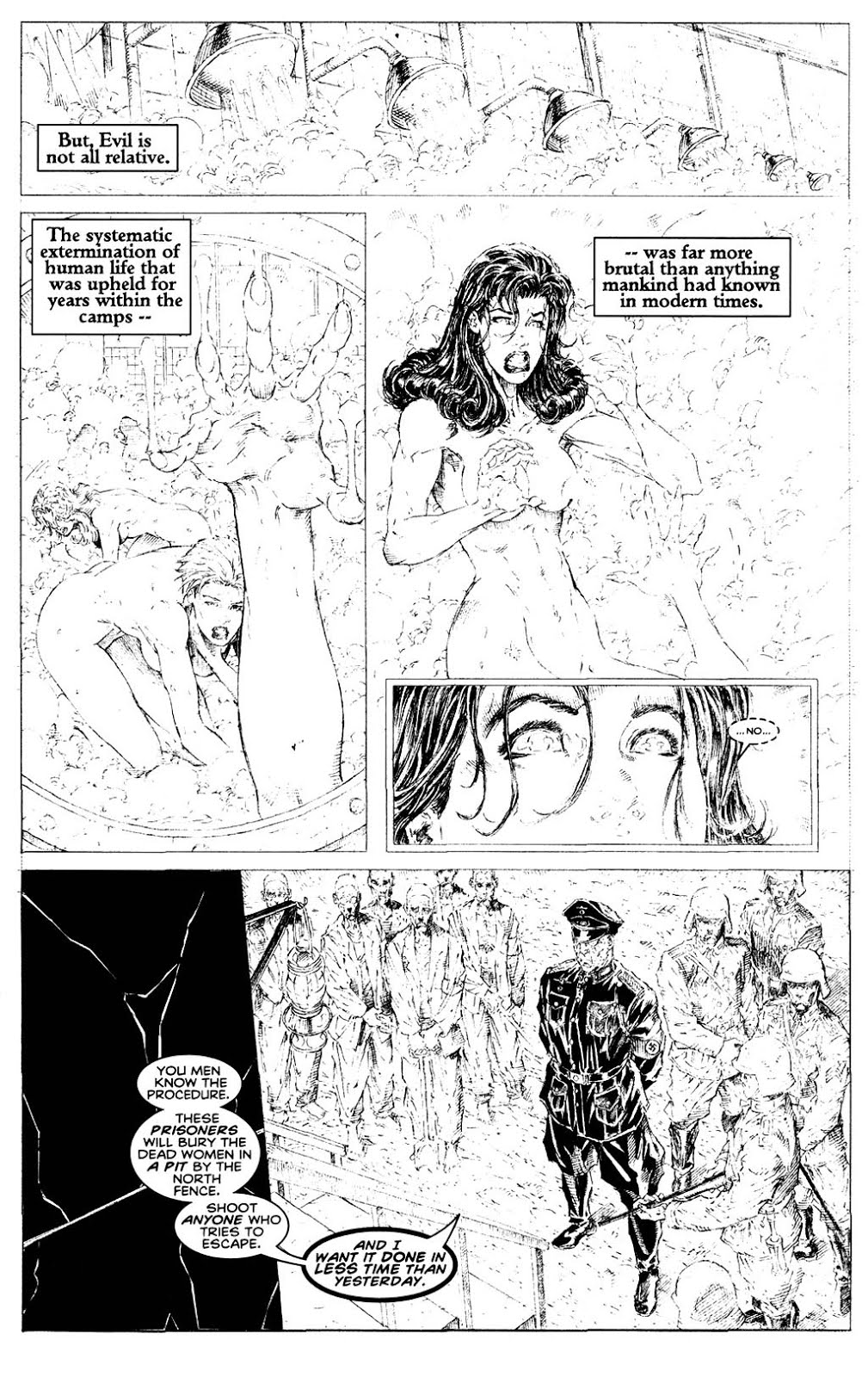
We got to see Christina care for the lost soul of a suicide victim. We got the origin of Scratch, which explained that the priest absorbed the demon within him so it couldn't get loose and do damage to the broader world (see, was that so hard?). And we got a dark story about the vampire, Fantom, herded into a Nazi concentration camp to be gassed, only to exact her revenge on the Nazis.

This last story was a little too similar to Magneto's origin form X-Men, but somehow that's only kind of a minor issue. Check out the page at right where he shows the starved, abused Jewish and other unwanted women herded into the gas shower stalls. They're all healthy, hot, beautiful women. Um... But at least they were trying to give us some reason to care for these character, which I guess is something.

A second series began in 1999 and crossed over with Supreme quite a bit, but I plan to save this for when we talk about Supreme: The Return. It's, for my money, the only interesting thing in the series that you might even want to consider trying to find.

From these nine or so issues, we got a spinoff called Lionheart, also by Churchill and Loeb, about a powerful heroine whose superpower must be keeping on one of the most ridiculously skimpy costumes! It's a bra with cutout pantyhose and arm-length gloves!

The short summary of Lionheart is that an archeologist comes across an artifact that lets her tap into half of the power God granted to humanity through the tree of knowledge (again, not what the Bible meant, but whatever). The other half is in the villain Blackheart, who immediately tries to kill Lionheart to get it all. The Coven get involved to help Lionheart, as does the archeologist's twin sister and Earnest Hemingway-inspired grandfather. There's no use getting too involved as the series lasted two issues and ended on a cliffhanger.

After Awesome collapsed for the final time, several of the characters were licensed out, including Coven, which then came out as a few miniseries by Avatar. (More on this when we get to Glory.)

Neither Loeb nor Churchill would work on these issues. Judging by their covers, I really don't want to even go through the motions of tracking them down, much less reading them. (Please don't make me.)

Churchill would go on to work for DC and Marvel after Awesome's collapse, drawing the "Code Red" story in Hulk and a spin-off of the Teen Titans. In 2010, he launched his creator-owned "Marineman," which received an Eisner nomination. So good for him.

Wednesday, November 15, 2017

Superman's Hell of Mirrors: The Phantom Zone

Aaron Severson, in an offhand comment in his excellent annotations (which are the basis for this site's Annotations page), mentioned how harsh the imprisonment of Supreme's rogues in the Hell of Mirrors is. There's no chance of parole. They're there for good.

Of course the Hell of Mirrors is based on the idea of the Phantom Zone from Superman. According to Wikipedia:

The Phantom Zone was discovered by Superman's father, Jor-El, and used on the planet Krypton as a method of imprisoning criminals. Previously, criminals were punished by being sealed into capsules and rocketed into orbit in suspended animation with crystals attached to their foreheads to slowly erase their criminal tendencies; Klax-Ar was one criminal who received this punishment but escaped. Gra-Mo was the last to suffer the punishment, for it was then abolished in favor of the Zone.

The inmates of the Phantom Zone reside in a ghost-like state of existence from which they can observe, but cannot interact with, the regular universe. Inmates do not age or require sustenance in the Phantom Zone; furthermore, they are telepathic and mutually insubstantial. As such, they were able to survive the destruction of Krypton and focus their attention on Earth, as most of the surviving Kryptonians now reside there. Most have a particular grudge against Superman because his father created the method of their damnation, and was often the prosecutor at their trials. When they manage to escape, they usually engage in random destruction, particularly easy for them since, on Earth, each has the same powers of Superman. Nevertheless, Superman periodically released Phantom Zone prisoners whose original sentences had been completed, and most of these went to live in the bottle city of Kandor.

The sole inmate of the Phantom Zone who was not placed there as punishment for a crime is Mon-El, a Daxamite who fell victim to lead poisoning. Superboy was forced to cast him into the Phantom Zone to keep him alive, where he remained until the time of the Legion of Super-Heroes when Brainiac 5 created a medication that allowed him to leave safely.

Superman developed communications equipment for the Phantom Zone, like the Zone-o-Phone, and refinements to the projector. In addition, the city of Kandor uses the Phantom Zone regularly, with parole hearings sometimes chaired by Superman. However, since the departure of Kandor, that is, outside of Mon-El, most of the inhabitants were confined to lifers and generally not inclined to making conversation with their jailer. As for Superman himself, as much as he appreciates how the Zone is necessary to contain its Kryptonian inmates and shelter Mon-El, he apparently privately harbors concerns about the justness of its penal use.

Interestingly, Moore briefly examined the idea of the Phantom Zone being too harsh of a punishment in his For the Man Who Has Everything story in Superman Annual #11. Widely regarded as the best Superman story ever written, Superman is tricked into thinking he lives on a fully-realized Krypton. Political forces are clashing between the more progressive younger generation and the more conservative older generation of his father. The younger generation have taken up Phantom Zone imprisonment as an issue, to the point of violence, which can be seen in these panels:


Of course Moore doesn't get into the moral ramifications of it in the pages of Supreme (unless he did so on the mysteriously disappearing page 24 of the first issue of Supreme: The Return). Then again, it didn't really seem like the inmates in his Hell of Mirrors had reformed, either.

Monday, November 13, 2017

Weekly Reading: Supreme #56

Supreme #56

Published by Awesome Entertainment in February 1998


The covers:


Title: The Mirror Crack'd from Side to Side...

(As always: Supreme is currently out of print. There are a number of ways to read it, which can be found on the How do I read Moore's Awesome works page.)

This is it guys - the breaking point. The beginning of the end. This two-parter that begins with this issue is the last story Chris Sprouse will do. After this issue was published, Moore stops working for Awesome, leaving behind several scripts and proposals that Liefeld and company will release intermittently at best.

1998 was a very cruel year.

At least this is a fun two-parter, so we can go out with a smile. So, let's get into it. We get two covers for this issue, as Awesome was doing a company-wide set of variants by Ed McGuinness doing his sort of chibi versions of characters (as we saw on Judgment Day: Aftermath). The other cover shows that Chris Sprouse finally figured out how to draw Suprema's costume.

Then we have the last of Todd Klein's credits pages:


We start the story with two suprematons getting us up-to-date on everything. Supreme is off with Diana; Suprema is off with Twilight in Star City, Radar is off in space. Amalynth is complaining about being in close proximity to Optilux, who turned them into living light. All of the suprematons are getting upgrades in consciousness to match the former S-1, now Talos, and might need a bill of rights, though maybe they don't want consciousness.

In the background, we see the Televillain take over all the screens before appearing in person. There's a fun chase as the suprematons talk in robot while chasing the Televillain: "Rhetorical question: Isn't that the Tellevillain?"

They chase him to the Hell of Mirrors, where he has let out the other villains. In addition to the Tellevillain, Korgo, Shadow Supreme, Sentinel and Slaver Ant (a bug woman) all escape, with Slaver Ant telling us that The End refused to go with them. Sentinel quickly takes off (we'll see him later in the pages of Youngblood) leaving the others to decide what to do. The Televillain and Slaver Ant find Optilux's prison, which can only spell trouble.

We cut to Ethan and Diana in Diana's apartment, where she's about to turn on Friends. In 1998, it would have been in its fourth season, having become quite the hit by this point. As they watch, the Televillain turns up on the show and guns down Monica and Rachel, threatening the TV networks that unless they pay him, he's going to kill their ratings.

"Pay up by tomorrow or I whack Commander Picard and the fruity robot guy!" he says. (That's Captain Picard to you!)

What a wonderfully ridiculous comicbook villain scheme.

Ethan goes to the phone to call the Kendalls to check on Sally. Taylor Kendall replies that she was there taking a look at Linda's new Twilight costume, but left to meet Radar at the Citadel.

Just a note on that middle panel. So, Twilight, who mentioned in Judgment Day that she thought modern superheroines had an interesting look, has updated hers. Gone is the innocent "Robin" sort of look for a leather and chains look that looks like something the Comedian might appreciate. Also, isn't it a little odd how Taylor is just sort of sitting there watching, with Linda's civilian clothes tossed off to the side. I don't know, maybe it's just me.

Ethan tells Diana that he's going to alert Supreme and tells her to stay inside. As he leaves, the television reports that the cast of Friends were fine, but the fictional ones on the show were not. Just another little touch of Moore suggesting the power of story over reality.

Back at the Citadel, the Tellevillain joins Slaver Ant, Korgo and the lion-headed alien executioner Vor-Em, who also left the prison. They decide to go cause some mischief, leaving the Shadow Supreme to kill suprematons.

A little later, Suprema flies down and sees Supreme in the distance and starts explaining how ridiculous Twilight's new costume is. But as she gets closer, she realizes that it isn't Supreme, but the Shadow Supreme covered in blood with Radar's body tossed aside. Suprema isn't the only one horrified by this.

Shadow Supreme does a number on Sally, threatening her with death and far worse, all because she helped wo kill Darius Dax, the Shadow Supreme's creator. This part goes on too long and probably goes too far in my opinion, but has to so that when Supreme shows up and says, "Leave my sister alone!" while giving him a good pounding, it's awesome.

The heroes are shellshocked by the death of Radar. They realize they need to recapture all of the villains before things get even more out of hand. Suprema volunteers to take the others if Supreme will handle the Shadow Supreme. Supreme tries to think back to why he created the Hell of Mirrors in the first place, which leads us into a Rick Veitch flashback!

Supreme is babysitting Judy Jordan's niece and nephew, Janey and Jimmy, and they want to know where the mirrors came from. Supreme explains that the mirrors are a barrier of hard light between our world and another. In the home of a vanished mathematician named Dodgson, he found a mirror that led into Lewis Carroll's Wonderland from the Alice books.

A literary world that was real. Of course.

Another thing to consider about this. Professor Night has a pair of villains, the Walrus and the Carpenter, whom we've seen a little bit of here and there. Up until this point, everyone who thought about it believed they were themed after the Alice villains, like the Mad Hatter in Batman books. But they're not. They're the real Walrus and carpenter!

Moore's idea of a shared literary universe in the Awesome universe just got a lot bigger.

Anyway, Supreme used the technology to construct his mirror prison. Supreme captured Korgo the space tyrant and Vor-Em and put them there. He tells Janey and Jimmy that he added the Shadow Supreme in 1958 and then the Televillain. Slaver Ant was added later after she tried to steal children and raise them as servants.

There's an interesting cut away to the statues of the League of Infinity in the Citadel, showing a smiling Wild Bill next to a smiling Witch Woman. Obviously this is intended to remind us that Bill died last issue and that Witch Woman was the one who suggested it. It's that interplay of the old and innocent with the modern and experience that makes Supreme work so well, even just casually as this image is.

Supreme tells about a time the Supremium Man II tricked his way out and the time the backward Supreme Emerpus tried to un-jail the prisoners as he would do in his own world. Jimmy asks why Supreme doesn't execute them, but Supreme says it's against his oath.

Back in the modern story, Supreme goes to confront the Shadow Supreme while Suprema puts out a fire he started. The Tellevillain goads her into chasing him as he leaps from TV antenna to TV antenna. He tells her that Korgo and Vor-Em headed to Washington while Slaver Ant is checking out maternity hospitals. Meanwhile, he set up a guest act in the form of Optilux at a Bon Jovi concert.

What happens next? Well, for those of us following along back then, we had to wait more than a year to find out. You just have to wait a week.

In the letters section, there was this little bit from a letter that caught my eye:


If sales were weak for Supreme and the other Awesome titles, you can see why an investor might pull out of the company. 

Drat.

This is where I say, "As always, please check out the Supreme Annotations Page, for all of the details and references that I completely missed," except I've run out of the Supreme annotations by Aaron Severson and am now doing them myself. Please help me by letting me know anything I missed that can be added to the annotations. Thanks!