
 I've already discussed Erik Larsen illustrating the last Alan Moore Supreme script back in this weekly reading. In May 2012, he started writing his own issues so we could see what happened when the Daxes attacked the Citadel in Supreme #64. I remember back in 2012 being so excited for the last Moore script that I was willing to overlook everything I had ever thought about Erik Larsen and give him the benefit of the doubt on his continuing with Supreme.
How could it go wrong?
It ended up being a short run where he brought back Rob Liefeld's "Mean" Supreme while also dealing with the fallout to Alan Moore's Supreme characters. "My thought was to marry the two and take what Alan had done and what came before and try to find something in the middle which might appeal to both audiences," he said.
Oh...yeah. That's how it could go wrong.
 Picking up immediately after Supreme #63, the Daxes downed the Citadel and when Supreme and Diana opened the door to the Supremacy, the Daxes blew up the Supremacy. They decimated all but a handful of the Supremes, including Radar (Larsen ignored the fact that Radar was off on his own planet). New Supreme and Original Supreme decide to let Rob Liefeld's Mean Supreme out of the prison where he'd been chained since Supreme #41. He kills all the Daxes and then finds silver supremium in the Citadel wreckage, which he uses to strip the five remaining Supremes of their powers.
It's not a particularly good start to Larsen's run for fans of Moore's Supreme.
 From there, Larsen separates the book into two parts. The first involves Mean Supreme feeling betrayed that no one came to rescue him for the last 24 issues (he acknowledges that it was a decade and a half). He goes and beats up Super Patriot, demanding to know why he didn't help. Super Patriot says that Supreme was always so confident, how were they to know he needed help, when he never needed it before.
 The better part of the book involves the five non-powered Supremes: New Supreme, Sister Supreme, Fifties Supreme (with lion head), Original Supreme and Squeak. When the military takes them into custody, Suprema goes to rescue them. But New Supreme tells her that they have to cooperate with the authorities.
 While Suprema goes to confront Mean Supreme, Ethan and Diana discover that Dazzle Comics and all the other aspects of their existence are gone, including Ethan's whole apartment building. When they go to Diana's apartment, she has a message on her answering machine from a boyfriend named Ken. Um, what? Did she always have a boyfriend or is that just in this new revision?
 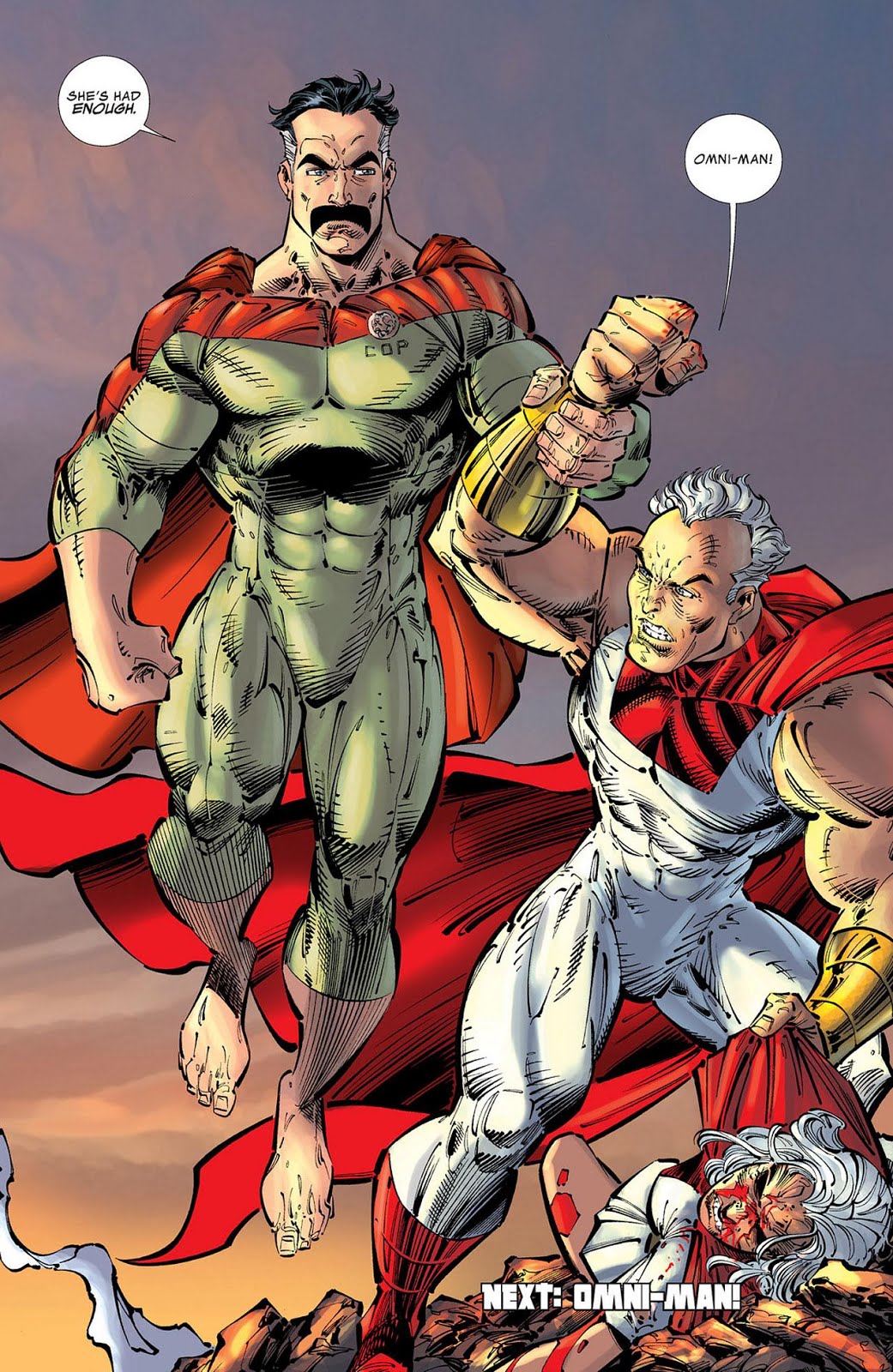 Suprema and Mean Supreme end up in a fight where Mean Supreme beats her into a bloody pulp that is so beyond the boundaries of good taste that I'm not sure how Larsen thought he could possibly appeal to fans from the Moore run. Just as he's about to finish her off, this revised universe's Omni-Man (an alien from Image Comics' Invincible series) comes and fights Mean Supreme to a standstill.
 Ethan rescues Suprema and takes her to the hospital. He is also thinking about moving on with his life and getting a new job as a comic artist. But the other non-powered Supremes want to do something about Mean Supreme. They decide to team up with the only Dax who survived the Dax massacre, Darius Duck, who gives them gloves that can help them steal Mean Supreme's powers.
Mean Supreme, unconscious from the fight with Omni-Man is abducted by an old Liefeld villain, Khromium, from an antagonistic alien culture.
 By issue #68, the writing was on the wall for the Erik Larsen series as Cory Hamscher, the artist who finished Larsen's layouts, left the series. The result looks like barely-finished chicken scratches, which suggests that no one finished the layouts and they just put it out anyway. But it doesn't really matter, since this was the last issue and it doesn't end with any real resolution.
While Mean Supreme kills Khromium and all of his race, Ethan realizes he doesn't have any artistic abilities without his Supreme powers. He ends up sleeping with Sister Supreme. They discuss whether it was even possible for the Daxes to have destroyed the Supremacy, since it was just a limbo realm, and that maybe the real versions of themselves with their powers are now in the real Supremacy. I took this as Larsen acknowledging the Moore fans who hated Larsen's version, and that their version still existed somewhere in the Supremacy.
 Meanwhile, Diana goes to see Suprema in a coma in the hospital. She says she remembers being Supreme's girlfriend and that she's pregnant.
The end.
Larsen has the audacity to say in the letters page that he always planned to "do the book but just long enough to set the pace and get the ball rolling. And now my job is done."
Bullshit. The sales on the series were awful and it was clearly cancelled before Larsen thought it was going to.
And as with all Rob Liefeld series, none of it mattered because the next team ignored all of this and did something new. We never find out if the Supremes are in the Supremacy. We never find out what happens with Mean Supreme, or Diana and her baby, or if Suprema recovers.
Now there's quite a lot of this arc on the series that I not only don't like, but actively hate. Everything with Mean Supreme, which was mostly mind-numbing overlong fight sequences, was a total waste. The way Larsen abuses his characters, especially shooting Radar and beating up on Suprema, show a complete disregard for common decency, which was one of the hallmarks of Moore's run on the series.
 But there are elements that work. The subplot about Ethan having lost his abilities to draw along with his Supreme powers is a nice touch, and almost everything involving the powerless Squeak is a lot of fun. While I don't like the idea of Ethan and Diana having a falling out, the character of Sister Supreme was a hoot and a unique character for Ethan to interact with. And Cory Hamscher's art really had a nice, comic look to it that made the series easy on the eye. There was potential here and I wonder what would have happened to these characters if the series had continued.
 Ultimately, these issues seem like a lost opportunity to continue Moore's series and find new stories to tell. Larsen was right not to try to duplicate what Moore did, but Larsen was the wrong choice to lead the series forward, as few people really missed Rob Liefeld's version of Supreme. And no one wanted him to try to split the difference between Moore and Liefeld.
Up next... wait, what? Yet another shitty version of Younglood? Yay.


