Welcome

So a long time ago (the mid-1990s), the greatest writer in comics agreed to take over the writing duties for Image Comics' Supreme. He would radically reshape the character, the book, and due to forces beyond his control, a whole comic book universe. And it led to an award-winning run of comics, three additional titles (among several proposed) and ultimately led to the genesis of Moore's much better known America's Best Comics. And then it all went out of print and was forgotten by way too many.

Having gathered quite a bit of information about Moore's Supreme and Awesome runs, I decided to create a home for the forgotten Awesome. Over the course of a year, I put it all together here.

Each week I did a main "Weekly Reading" post that was a read-through of that issue. I followed that up with a couple of other posts about topics from that Weekly Reading or whatever else I came up with to talk about. You'll find the lost Youngbloods in the Youngblood section and the fan-edit of the last Supreme in After Awesome.

Below is the archive of posts broken up by book. Thanks for checking the site out!

Book 1: Supreme: The Story of the Year

Book 1: Judgment Day

Book 3: Supreme: The Return

Book 4: Youngblood

Book 5: Glory

Book 6: After Awesome

Book 7: 1963

Book 8: Night Raven

Book 9: A Small Killing

Wednesday, August 9, 2017

Covering The Allies with the Justice League of America

As mentioned in the Weekly Reading for issue 48, Veitch and Moore had developed a shorthand for their flashbacks by showing the covers of the issues for the stories they were quickly recalling. As these are the closest homages they've done to the DC Universe yet, I though it'd be fun to do a post where we see Veitch's Allies covers and the Justice League of America covers that inspired them. I only caught two of them, so I decided to use the explanations come from the annotations page, which is worth checking out.


The Allies’ first foe was Florax the Dominator, an intelligent orchid from interstellar space who could enslave humans with her scent. Florax is reminiscent of Starro the Conqueror, a giant, intelligent starfish, who was the first enemy faced by the JLA. Starro could produce miniature versions of himself that allowed Starro to control a victim’s mind when the starfish was attached to their face.

This “cover illustration” is closely modeled on the cover of Brave and the Bold #28 (the first appearance of the JLA and of Starro) by Mike Sekowsky and Murphy Anderson, down to the lettering style and the Allies logo, which is highly reminiscent of the original Justice League of America logo.

The “Funny Book Federation Decal of Decency” is based on the “Approved by the Comics Code Authority” seal carried by most mainstream comics from 1954 to the late eighties (notably removed for some Alan Moore stories in Swamp Thing).


The “cover illustration” of Allies #16, “Servants of the Soul-Slaver,” is reminiscent of the cover of Justice League of America #3. That cover, drawn by Murphy Anderson, showed the JLA as unwilling oarsmen of a boat commanded by the issue’s villain, the alien tyrant Kanjar Ro of the planet Dhor.

Hulver Ramik the Slaver of Souls, bears some resemblance to the Justice League of America villain Despero, a red-skinned, three-eyed mutant from the world of Kalanor who first appeared in Justice League of America #1 (October-November 1960).


Supreme refers to the “time door” which opened between the forties and sixties allowing the Allies to meet themselves as the Allied Supermen of America. Similarly, starting in the early sixties, the Justice League of America frequently met their counterparts in the Justice Society of America, although their meetings were accomplished by traveling to an alternate dimension, not through time.

In 1961, in The Flash #123, it was established that the heroes of the forties, including the original Flash (Jay Garrick), lived on a parallel world called Earth-Two, while the modern heroes, including Barry Allen, the Silver Age Flash, lived on Earth-One. The two worlds occupied the same space but vibrated at different frequencies so that they never intersected. Barry Allen, who could control his own internal vibrations, discovered that he could travel to Earth-Two by tuning in its particular vibrational frequency. There, he met his forties counterpart, who in Barry’s world had only existed as a comic book character (it was further suggested that writer Gardner Fox, who had penned most of the Flash’s Golden Age adventures, wrote the stories based on psychic impressions that he received from Earth-Two in his dreams). Later, in The Flash #137, Barry met Jay Garrick’s comrades of the Justice Society of America, who came out of retirement to help the two Flashes defeat the villain Vandal Savage.

Not long afterward, the Justice Society arranged its first meeting with Earth-One’s Justice League of America (in JLA #21-#22), teaming up to fight a group of super-villains from both worlds. This afforded the modern heroes the opportunity to meet their Golden Age counterparts; for instance, the original Hawkman (Carter Hall, the reincarnation of an Egyptian prince) met the modern Hawkman (Katar Hol, a policeman from the planet Thanagar). The JLA and JSA heroes were separate individuals and not different temporal versions of each other; however, several of the JLA members, whose adventures had been published continuously from the forties through the sixties, had counterparts on both Earths. Therefore, there were older and younger versions of Wonder Woman, Robin (whose Earth-Two counterpart was now an adult), Superman, Green Arrow, and Batman.

The “cover” of Allies #21 (“The Cross-Time Catastrophe”) is modeled closely on the cover of Justice League of America #21, which was drawn by Mike Sekowsky and Murphy Anderson. That issue showed the first teaming of the Justice League with Earth-Two’s Justice Society of America, in a story called “Crisis on Earth-One!” Its cover featured a banner proclaiming, “Back After 12 Years! The Legendary Super-Stars of the Justice Society of America!”

The Allies’ first meeting with their forties selves is said to have been brought about by the forties villain Doctor Clock and Glory’s sixties enemy the Time Tinker. In the forties, the Justice Society of America had a time-traveling foe named Per Degaton, first encountered in 1947 (All-Star Comics #35), who made four attempts to conquer the world by altering the past. In the most convoluted of those efforts, he time-traveled from 1947 to the parallel world of Earth-Prime in 1963, and then to Earth-2 in 1942, where he attempted to conquer the world with nuclear weapons stolen from Earth-Prime. Degaton ultimately was thwarted by the combined efforts of the Justice League, the modern Justice Society, and the wartime All-Star Squadron, which included younger versions of some of the Justice Society members (Justice League of America #207-#209 and All-Star Squadron #14-#15). Wonder Woman, of whom Glory is a counterpart, had a time-traveling enemy called the Time Master, who first appeared in Wonder Woman #101 (1958).

Supreme remarks that “we met ourselves every year.” Similarly, the meetings between the JLA and JSA became an annual event for more than two decades.


The former Allies recall the Fisherman: a playboy and “angling champion” who became a crime fighter along with his partner Skipper. His real name was Bryce Bristow. The Fisherman is analogous to Green Arrow, a crime-fighting archer who debuted in More Fun Comics #73 in 1942. Green Arrow was playboy Oliver Queen, who became an expert archer after being stranded on a remote island where he built a bow for hunting. Green Arrow’s sidekick was Speedy, secretly Queen’s ward Roy Harper. It should also be noted that DC has a villain called the Fisherman, who also used a fishing pole as a weapon; he first appeared in Aquaman #21 (1965).

The Fisherman joined the Allies after helping them to defeat the Moth-Empress, a “dominatrix” from another world who made the Allies her mind-slaves. Green Arrow joined the Justice League of America in Justice League of America #4 (1961); the cover for Allies #28 (“Minions of the Moth-Empress) is loosely based on the cover of that issue. The Moth-Empress is based on the JLA villain Zazzala, the Queen Bee, an alien monarch from the planet Qorll who could control the minds of others with her “radiation rod.” She first encountered the JLA in Justice League of America (1963).
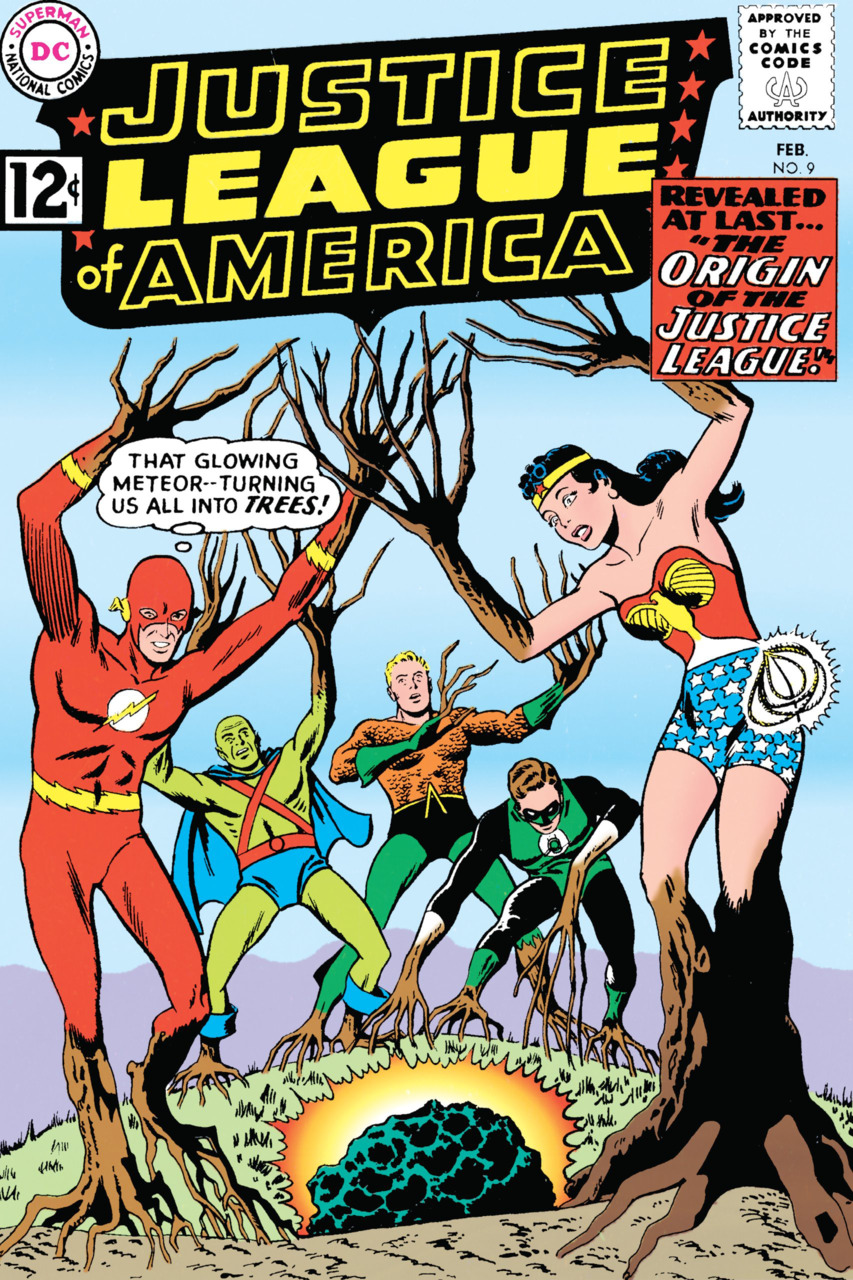


The cover of Allies #24 is based loosely on that of Justice League of America #9 (1962), “The Origin of the Justice League,” which showed the JLA transformed into trees by an alien meteorite.

The villains the Patriot mentions -- the Basilisk, Ecto-Man, and the Wizard of Blizzard -- each of whom caused bizarre transformations of the JLA, are reminiscent of the villains of JLA #9, aliens from the planet Appellax. The Appellaxians, who took the form of creatures of stone, glass, mercury, gold, fire, wood, and crystal, attempted to turn humans into stone, glass, etc., before they were defeated by the heroes, who decided to join together as the Justice League.


The cover of Allies #37, “The Deadly Daubs of Prismalo the Painter,” is loosely based on that of Justice League of America #1 (1960), which shows the villain Despero playing chess with the Flash. The villain snickers, “I’ve got this game rigged so that every time the Flash makes a move, a member of the Justice League disappears from the face of the Earth!”

Monday, August 7, 2017

Weekly Reading: Supreme #48

Supreme #48

Published by Maximum Press in May 1997


The cover:


Title: Just Imagine...

(As always: Supreme is currently out of print. There are a number of ways to read it, which can be found on the How do I read Moore's Awesome works page.)

Welcome to the last issue of Supreme under the Maximum imprint. Starting with issue 49, things get a whole lot more Awesome. This is a great issue for a lot of reasons, but let's get some of the housekeeping out of the way first.

We get a new modern artist this month in Mark Pajarillo. He had worked on some Image titles before this and would go on to work for DC for a bit before leaving the comics industry altogether to go into video game graphics. He's capable enough in this issue and has a few moments of real beauty, though maybe not for long, as we'll see later. Anyway, let's dig in.

We start with the first-person perspective of Glory as she flies to the Citadel and is greeted by one of the suprematons, who escorts her to the gathering of others. There, she finds Supreme, Mighty Man, Super Patriot, Die Hard and Roman, as Supreme is suggesting that The Allies reform to take on Hulver Ramik in order to rescue the souls of Twilight and Professor Night (as we learned last issue).

[As a side note, Moore didn't create The Allies. The Allies first showed up in Youngblood Strikefile #1, but the team only consisted of Die Hard, Glory and Super-Patriot. Later, Supreme was added (as seen in Supreme Glory Days)  and also Battlestone... but he was more just a government operative. Later, Roman was added as well. They planned an Image series to be written by Swamp Thing creator Len Wein, as see from the ad below...


...but it never came out. But leave it to Moore to turn them into a full-on Justice League analog. Thanks to Rob Messick and Derek Mont-Ros for the info.]

There are some nice little jokes and details in here, like that Glory flies by riding air currents and that Roman regrets having a mercave lair with a seashell throne. There's also some weird little bits with Super Patriot, who we can see electronically plugged in at one point, and Die Hard, who says, "When you suggested this mission back in Omegaopolis, I was skeptical. Now I feel almost a simulation of enthusiasm." So that's two of them that are cyborgs. Well, it was the '90s.

They then remember their first case from 1960, years after disbanding the Allied Supermen of America, when they battled Florax, a dominating space plant! And then we get our first Rick Veitch flashback...


...but not really. What we get is the cover, an obvious play off of The Brave and the Bold #28 (the first appearance of the Justice League of America), who battled the mind-controlling starfish, Starro!


In the Awesome Universe, The Allies were able to defeat Florax thanks to Space Hunter (a character we haven't met yet). And then we're back to the modern story.

I love this device for quickly flashing back to various points in the group's history. Moore and Veitch couldn't have gotten away with this in the first few issues of their run on Supreme, but now that we understand more about Supreme, his history and how the flashbacks work, they're able to create this shorthand and have the audience understand what's happening.

I remember the covers adding to the debate among fans about whether the characters realize they're comic book characters or not. However, the way that they talk about those flashbacks suggest that it's only the audience who realizes that they're referring to old issues and they just remember it as their pasts. Anyway, I'll look at more of these covers in a post later this week.

The gathered heroes don Supreme's headsets and prepare to enter thought space. The suprematons explain that they will keep a watch on things and report that Billy Friday has been rescued by Emerpus, the reverse Supreme, and is now in the backwards zone. What seems like a running gag will pay off, just wait.

And then the heroes enter idea space. I talked about the importance of idea space in a post last week, so I'll try not to repeat myself here, but I love this image of them entering the realm of thought. The strange mix of space and logos and faces, with the use of negative space is really alien, yet beautiful.


As Supreme explains, this is the local neighborhood of mind-space, focused on advertisements and celebrities. As Super Patriot says, "Almost like cyberspace." And yeah, if you thought of how a comic book illustrator might draw cyberspace, this doesn't seem far off.

They head through the area dealing with language, reasoning and numbers and then into a stormy area representing emotions. Super Patriot wonders why he doesn't remember this from when they faced Hulver Ramik before, which Supreme explains that they were pulled straight to Ramik's realm. There's a nice joke about Glory keeping the minutes to their old adventures (because Wonder Woman was initially just the secretary of her old team) that leads to another flashback.

These flashbacks are stuffed with bits of meta humor. I love how the casebook title is the same as the story's title. And Glory complaining about how she always used to get bound up in the 1960s. Anyway, we learn Ramik is a soul slaver, who sells souls to the highest bidder.

And now the heroes are swimming through the realm of archetypes and symbols, where we see plenty of religious symbolism. This is where many of the ideas in Supreme's mythopoeic zoo come from. But they're not the only creatures living here, as the heroes are attacked by some H.P. Lovecraft-inspired old thing. As Supreme explains, there is no time in idea space, so things come from the past, present and future to intermix.

And that brings up a time travel flashback from when The Allies met the Allied Supermen of America (a riff on Justice League of America 21, when the Justice League and the Justice Society met for the first time and proved so popular, they kept meeting).

Back to Idea Space, they find a cloud that starts to mess with their thoughts. They manage to push through the defensive barrier to find a hidden prison of souls of all the missing heroes. There's Professor Night, Twilight, Space Hunter, Janet Planet, Blake Baron - Occult Agent, Polyman, the Stormbirds, the Conquerors of the Uncanny, Jungle Jack Flynn, and the Fisherman, a forgotten member of The Allies.

Flashback to when he joined. The Fisherman was a wealthy playboy and angling champion who took to capturing criminals with his sidekick, Skipper. While an obvious play on the Green Arrow, Moore's love of the ridiculous silver age may have gone too far with the concept of the Fisherman.

The heroes head in to attack Ramik and his mercenary prison guards, but not until we get another flashback. The attack goes well, which infuriates Ramik, as he's just about to sell the superhero souls to his client. And flashback to the oddball case of Prismalo the Painter.

Back to Ramik's prison, the heroes have Ramik on the ropes. And that's when his client shows up: Supreme's longtime foe Optilux. But that will have to wait until next month. I hope you had as much fun with this one as I did.

From the ongoing "Adventures in bad promotion," we get five pages devoted to the upcoming Judgment Day miniseries. Five pages in which they use the same two images over and over again. Probably the most questionable thing they did was run the quote from American Entertainment (not from a review in an unbiased magazine, but from a company that hyped and sold comics directly) that "Judgment Day is Alan Moore's next Watchmen." I'm sure that line sold some comics, but it misrepresented exactly what Judgment Day was and was meant to be. How did they expect it to live up to the greatest graphic novel ever written?


As always, please check out the Supreme Annotations Page, for all of the details and references that I completely missed.